
Among Sensex shares, Infosys, Tata Consultancy Services, Tech Mahindra, Sun Pharmaceutical, Bajaj Finserv, HCL Technologies, Bajaj Finance, HDFC Bank, IndusInd Bank and Kotak Mahindra Bank were among the gainers. Tata Motors, PowerGrid, Axis Bank, State Bank of India, NTPC, Tata Steel and Adani Ports were the major laggards.

This marks a rebound after more than two years of underperformance during a strong rally in smallcap stocks.

When it comes to multibagger stocks, patience trumps market timing. Investors who stay invested in fundamentally strong stocks build wealth in the long term, and investors who wait for perfect entry points usually end up confused, late, or out of the market. Here, we will explore the role of patience in multibagger stock investments.

The recent evolution in the passive space has given rise to a new category of funds promising to deliver "active" returns through a structured passive approach. These are often referred to as smart beta or factor-based index funds, and they represent a compelling middle ground for investors.

So far in 2017, the Nifty has gone up by 22.4 per cent.

The last time these two indexes recorded a negative performance on a calendar year basis was in CY19.

Analysts remain bullish on the road ahead for the equity markets, but warn against volatility on account of domestic and global cues. The upcoming Lok Sabha elections back home and the interest rate trajectory of the US Federal Reserve, they said, will be the two most important factors that the markets will keep a tab on. That apart, the valuation of the Indian markets, they feel, will also be eyed in context of how global peers are performing.

Ask rediffGURU and PF expert Nitin Narkhede your mutual fund and personal finance-related questions.

After a strong run in the midcap and smallcap indices, which surged 46 per cent and 43 per cent, respectively, on the National Stock Exchange (NSE) during Samvat 2080, analysts suggest that the rally in these segments may pause to catch its breath in Samvat 2081.

The Reserve Bank of India (RBI) on Friday delivered a 25 basis point (bps) repo rate cut analysts expected, driven by the strong 8.2 per cent GDP growth in the September quarter. However, analysts do not expect a runaway market rally as the impact of US tariffs continues.

Ask rediffGURU Reetika Sharma your insurance, mutual fund and personal finance-related questions.

'Such stocks may be useful for aggressive portfolios, but should not be part of the core holdings.'

In June, Sensex went up 6.6% and Nifty 6.9%, their best monthly gains since December 2023.
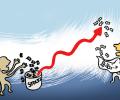
The worst may perhaps be over for these stocks, suggests Sanjay Kumar Singh.

Finance, ICICI Bank, Mahindra &h Mahindra, Kotak Mahindra Bank and Titan were among the gainers. Bharti Airtel, Adani Ports, Tech Mahindra, Reliance Industries, Axis Bank, Larsen & Toubro were the laggards.

As regards mid-caps and small-caps, analysts suggest investors buy only those stocks of those companies where there is earnings visibility for at least a few quarters and where the valuations have become reasonable.

The BSE Small-Cap Index (up 34 per cent) and the BSE Mid-Cap Index (up 28 per cent) have outperformed the Sensex (up 16 per cent) in the last two-and-a-half months, while the NSE Junior Nifty (up 25.4 per cent) and the NSE Mid-Cap Index (up 30.2 per cent) have beaten the S&P CNX Nifty (up 20.4 per cent) during the same period.

Among the Sensex constituents, Asian Paints, Tech Mahindra, HCL Technologies, Tata Steel, Maruti Suzuki India, Sun Pharmaceuticals, Tata Consultancy Services, ICICI Bank, Bajaj Finance, UltraTech Cement, Mahindra & Mahindra and Tata Motors Passenger Vehicles were the laggards. However, Eternal, Titan, Adani Ports, Bharat Electronics Ltd, State Bank of India, Bajaj Finserv, NTPC and Bharti Airtel were among the gainers.

Investing in gold trumped most other asset classes in terms of compounded annualised returns over the long term, suggests a report by FundsIndia.

Notwithstanding the risk involved, analysts are upbeat on micro-cap investing as India remains in a firm bull market. Moreover, these stocks are available at relatively cheaper valuations compared to large, mid and small caps, assuring alpha returns. With a market-capitalisation (market-cap) of up to Rs 10,000 crore, micro-cap stocks are outside the purview of Nifty 500 stocks, and are ranked from 501 to 750 in the market-cap ladder.

Passive funds appeal to investors seeking to avoid the risk of underperformance by the fund manager and minimise the need for frequent chopping and changing of funds.

Tracking losses in the broader market that has seen the Nifty Smallcap 250 index and the Nifty Midcap 100 indices slip 9 per cent 6.1 per cent in the last three sessions, the frontline Nifty 50 index has remained resilient and registered a fall of 2.2 per cent during this period. Going ahead, can the nervousness in the mid- and small-cap universe spread to the large-cap peers? Most analysts do not think so. They expect a minor dip and a sharp recovery as investors flock to the large-caps in search of safety and value buying as the mid-and small-caps falter.

Over 50 per cent, or 660 stocks, from the BSE 1000 index recorded negative returns during CY25.

Stock markets will be driven by RBI's interest rate decision, tariff-related developments, global trends and trading activity of foreign investors in this holiday-shortened week, analysts said.

Among the 30-share Sensex pack, State Bank of India, Reliance Industries, Hindustan Unilever, NTPC, Larsen & Toubro, Nestle India, Power Grid, ITC, JSW Steel and Sun Pharmaceuticals were the major gainers. On the other hand, HDFC Bank, Titan, Mahindra & Mahindra, IndusInd Bank, UltraTech Cement, Tata Motors, HCL Technologies and Asian Paints were among the laggards.

Domestic passive mutual fund (MF) schemes will have to sell around Rs 1,500 crore worth of ITC Hotels shares once the demerged entity lists on the exchanges, according to estimates. Passive MF schemes - especially those tracking the Nifty 50 and Sensex - will have to offload their holdings in ITC Hotels as the stock will be excluded from the indices.

'We suggest an equity strategy of 5% to 10% exposure to cash, 5% to Gold ETF, close to 50% to Sensex/Nifty/large mid-cap stocks.'

Among major Sensex gainers, Mahindra & Mahindra rose the most by 3.29 per cent. Adani Ports gained 1.26 per cent, Tata Motors by 1.14 per cent, and Axis Bank by 0.92 per cent. Nestle, NTPC, Reliance, ITC Titan, Kotak Bank, Infosys and TCS also gained. HCL Tech, Tech Mahindra, and ICICI Bank were the losers.
Emerging business theme-based funds basically invest into mid and small-cap stocks, which normally have the potential to grow faster.

The net inflow into equity mutual funds surged 24 per cent to Rs 23,587 crore in June, reversing the declining trend of the last five months, driven by strong equity market performance across segments, data released by the Association of Mutual Funds in India (AMFI) showed on Wednesday. Also, the latest fund infusion by investors marks the 52nd consecutive month of net inflows into the segment.

From the Sensex firms, Eternal climbed 3.32 per cent. Bharti Airtel, IndusInd Bank, Tech Mahindra, Reliance Industries, Tata Motors, HDFC Bank, Tata Steel and Hindustan Unilever were the other major gainers. However, Bajaj Finserv, Axis Bank, Tata Consultancy Services, Titan and Larsen & Toubro were among the laggards.

Ask rediffGURU Reetika Sharma your insurance, mutual fund and personal finance-related questions.

From the 30 Sensex firms, NTPC, Nestle, Titan, Kotak Mahindra Bank, Maruti, Hindustan Unilever, Bharti Airtel and HDFC Bank were the biggest gainers. HCL Technologies, Tata Consultancy Services, Adani Ports, Larsen & Toubro, JSW Steel, State Bank of India, Tech Mahindra and Bajaj Finance were among the laggards from the pack.

Benchmark Sensex closed above the 85,000 level for the first time while Nifty scaled the 26,000 peak at close on Wednesday as fag-end buying in banking and power shares helped stock markets recoup early losses. After a see-saw trade during the day, the 30-share BSE Sensex rose by 255.83 points or 0.30 per cent to settle at an all-time high of 85,169.87. During the day, it surged 333.38 points or 0.39 per cent to hit a record intra-day peak of 85,247.42.

While selecting a smallcap scheme, go with one that has a good track record and a stable fund manager.

'A staggered investment approach (using SIP or STP) can help investors benefit from this opportunity while reducing timing risk.'

IndusInd Bank was the top loser in the Sensex pack, shedding around 2 per cent, followed by Titan, Tata Steel, M&M, Bajaj Finance and SBI. On the other hand, Bharti Airtel, HCL Tech, Tech Mahindra and Kotak Bank were among the gainers. NSE Nifty inched 8.95 points lower to 16,249.85 in early trade.

Mutual funds recorded Rs 7,600 crore net inflows into active equity schemes in July even as redemptions surged to a 30-month high of Rs 30,400 crore owing to profit booking, reveals data from the Association of Mutual Funds in India (Amfi). Equity net inflows were 13 per cent lower compared to the preceding month's tally. The inflows were supported by a strong flow from retail investors through the systematic investment plan (SIP) route.

Draft Red Herring Prospectus (DRHP) filing continued to be robust in October, signifying the optimism in the initial public offer (IPO) market despite the recent turbulence in equities. In October, 17 companies filed their offer documents for IPOs. The rush in filings has made August-October 2023 the best three-month period for DRHP filings since July-September 2021.

The latest circular from BSE that sought to cap the price movement of select scrips, especially the mid-, small-cap segments, traded on the exchange is not without a reason. A quick calendar year-to-date price check on the stocks from the categories put under 'Add-on Price Band Framework' by the BSE reveals a total of 210 stocks have seen their market price more than double. Among individual stocks, SC Agrotech, Adinath Textiles, Waaree Renewable Technologies, Steel Strips Infrastructure, Unistar Multimedia, Texel Industries, Raja Bahadur International and Hindustan Everest Tools from the BSE's X and XT group have rallied over 500 per cent during this period. Topping the charts is Gita Renewable Energy, which has zoomed 3,964 per cent to Rs 272.35 now from Rs 6.7 as on December 31, 2020.
